A network administrator has been told that the company IP address infrastructure must adhere to RFC 1918. What three IP address ranges from RFC 1918 could the administrator use on the network? (Choose three.)
10.0.0.0/8
127.0.0.0/8
169.254.0.0/16
172.16.0.0/12
192.168.0.0/16
209.165.201.0/27
Refer to the exhibit. What can be concluded from the output shown in the exhibit?

Refer to the exhibit. What can be concluded from the output shown in the exhibit?
The routing table is limited to 2 routes.
The LAN interfaces are participating in the routing process.
One update has been sent out of each serial interface and 2 have been received.
The no auto-summary has not been configured on this router.
Refer to the exhibit. What effect will the commands that are shown have on RIP updates for Router1?

Refer to the exhibit. What effect will the commands that are shown have on RIP updates for Router1?
Only version 2 updates are sent to 255.255.255.255.
Only version 2 updates are sent to 224.0.0.9.
Both version 1 and version 2 updates are sent to 224.0.0.9.
Both version 1 and version 2 updates are sent to 255.255.255.255.
Refer to the exhibit. Routers East and West are configured using RIPv1. Both routers are sending updates about their directly connected routes. The East router can ping the West router serial interface and West can ping the serial interface of East. However, neither router has dynamically learned routes from the other. What is most likely the problem?

Refer to the exhibit. Routers East and West are configured using RIPv1. Both routers are sending updates about their directly connected routes. The East router can ping the West router serial interface and West can ping the serial interface of East. However, neither router has dynamically learned routes from the other. What is most likely the problem?
A gateway of last resort is required.
Subnetting is not supported by RIPv1.
VLSM is not supported by RIPv1.
One of the routers needs a clock rate on the serial interface.
What are two reasons to implement RIP version 2 rather than RIP version 1? (Choose two.)
RIP version 2 supports VLSM.
RIP version 2 supports more than 16 routers.
RIP version 2 supports classful (and not classless) routing.
RIP version 2 supports routing update authentication.
RIP version 2 supports multi-areas.
RIP version 2 uses the Dijkstra algorithm rather than the Bellman-Ford algorithm.
A network administrator installed four new routers that are running RIPv2. Router1 is a boundary router in the RIPv2 network and has a default route configured. Once the network has converged, the network administrator enters Router1(config-router)# default-information originate on Router1. How will this affect the network?
prevents Router1 from forwarding updates about networks that are not directly connected
causes all routers in the network to synchronize routing updates with Router1
forces Router1 to become the primary or designated router (DR) for updates
propagates the default route to all routers in the network
is vmware player free ?
 |
| vmware player |
Yes! vmware player is free opposed to VMWare Workstation Which you have to buy. You Can download vmware player at vmware.com
Is VirtualBox Free ?
 |
Yes! VirtualBox is free Open Source Software release under the terms of the GNU General Public License (GPL). You Can download oracle virtualbox at virtualbox.rog.
What field was added to the RIP message header by RFC 1723 to add support for VLSM and CIDR?
subnet mask
destination port number
address family identifier
source and destination IP addresses
How are RIP v1 and RIP v2 similar to one another? (Choose three.)
They both use hop count as a metric.
They both have the same metric value for infinite distance.
They both broadcast their updates to their neighbors.
They both send subnet mask information in their updates.
They both provide for authentication of update sources.
They both use split horizon to prevent routing loops.
Refer to the exhibit. A network technician enters the static route in R1 needed to reach network 10.1.1.0/24. A ping from R1 to Host B fails. The technician begins testing the network and has the following results:
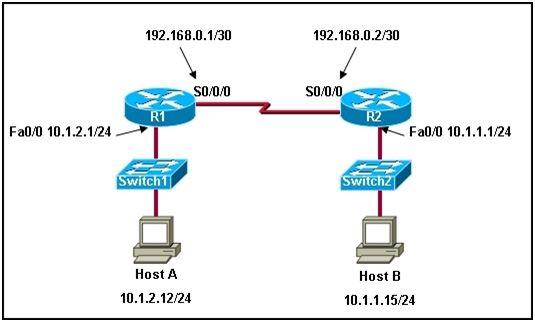
Refer to the exhibit. A network technician enters the static route in R1 needed to reach network 10.1.1.0/24. A ping from R1 to Host B fails. The technician begins testing the network and has the following results:
1. pings from R1 to the S0/0/0 interface on R2….successful
2. pings from R1 to the Fa0/0 interface on R2….successful
3. pings from Host B to hosts on the 10.1.1.0/24 network….successful
4. pings from Host B to the Fa0/0 interface on R2….successful
5. pings from R2 to Host B….successful

Subscribe to:
Posts (Atom)
Popular Posts
-
service provider edge enterprise WAN applications and devices services module
-
HA DRS FT Storage DRS
-
Subnet masks will be added to the routing updates. Routing updates will be sent out using multicast address 224.0.0.9. Version 1 and 2 up...
-
R001 : VMware HA must be functional. R002 : VMware SRM can be used between two sites for DR processes. R003 : You must be able to see all ...
-
It will revert to the user mode. It will perform an auto-complete function. It will go into the global configuration mode. It will give a...
-
debug chap authentication debug ppp chap authentication debug authentication debug ppp authentication
-
 Refer to the exhibit. Routers RTRA and RTRB are running OSPF. What entry does RTRA add in the routing table when Serial 0/0/0 receives a...
 -
used to mark routes as unreachable in updates sent to other routers prevents regular update messages from reinstating a route that may have...
-
Spanning Tree Protocol (STP) Dynamic Trunking Protocol (DTP) Router Information Protocol (RIP)
