require no device configuration
provide routers with up-to-date routing tables
require less processing power than static routes require
consume bandwidth to exchange route information
prevent manual configuration and maintenance of the routing table
Refer to the exhibit. The network in the exhibit is fully operational. What two statements correctly describe the routing for the topology that is shown? (Choose two.)

Refer to the exhibit. The network in the exhibit is fully operational. What two statements correctly describe the routing for the topology that is shown? (Choose two.)
192.168.0.2 is the next-hop address that is used by R3 to route a packet from the 10.0.0.0 network to the 172.16.0.0 network.
10.0.0.1 is the next-hop address that is used by R1 to route a packet from the 192.168.12.0 network to the 10.0.0.0 network.
192.168.0.1 is the next-hop address that is used by R1 to route a packet from the 192.168.12.0 network to the 172.16.0.0 network.
172.16.0.1 is the next-hop address that is used by R3 to route a packet from the 10.0.0.0 to the 172.16.0.0 network.
192.168.0.1 is the next-hop address that is used by R2 to route a packet from the 172.16.0.0 network to the 192.168.12.0 network.
192.168.0.2 is the next-hop address that is used by R2 to route a packet from the 172.16.0.0 network to the 192.168.12.0 network.
Refer to the exhibit. A network administrator notices that there are too many broadcasts on the network. What two steps can the network administrator take to resolve this problem? (Choose two.)
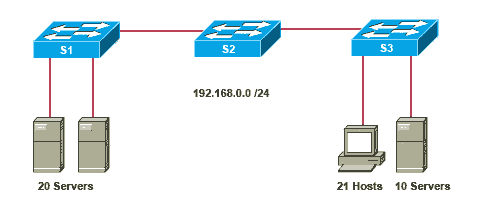
Refer to the exhibit. A network administrator notices that there are too many broadcasts on the network. What two steps can the network administrator take to resolve this problem? (Choose two.)
Replace S2 with a router.
Place all servers on S1.
Disable TCP/IP broadcasts.
Subnet the 192.168.0.0 /24 network.
Disable all unused interfaces on the switches.
Refer to the exhibit. A network administrator is troubleshooting a connectivity problem and needs to determine the address that is used to forward network packets out the network. Using the netstat -r command, the administrator would identify which address as the address to which all hosts send packets that are destined for an outside network?

Refer to the exhibit. A network administrator is troubleshooting a connectivity problem and needs to determine the address that is used to forward network packets out the network. Using the netstat -r command, the administrator would identify which address as the address to which all hosts send packets that are destined for an outside network?
10.10.10.26
127.0.0.1
10.10.10.6
10.10.10.1
224.0.0.0
Which three statements are true about routes and their use? (Choose three.)
If no route to the destination network is found, the packet is returned to the previous router.
If the destination network is directly connected, the router forwards the packet to the destination host.
If multiple network entries exist for the destination network, the most general route is used to forward the packet.
If no route exists for the destination network and a default route is present, the packet is forwarded to the next-hop router.
If the originating host has a default gateway configured, the packet for a remote network can be forwarded using that route.
If a host does not have a route manually configured for the destination network, the host will drop the packet.
If the destination network is directly connected, the router forwards the packet to the destination host.
If multiple network entries exist for the destination network, the most general route is used to forward the packet.
If no route exists for the destination network and a default route is present, the packet is forwarded to the next-hop router.
If the originating host has a default gateway configured, the packet for a remote network can be forwarded using that route.
If a host does not have a route manually configured for the destination network, the host will drop the packet.
Refer to the exhibit. All devices shown in the exhibit have factory default settings. How many broadcast domains are represented in the topology that is shown?

Refer to the exhibit. All devices shown in the exhibit have factory default settings. How many broadcast domains are represented in the topology that is shown?
3
4
5
7
8
11
What are three common problems with a large network? (Choose three.)
too few broadcasts
performance degradation
security issues
limited management responsibility
host identification
protocol compatibility
performance degradation
security issues
limited management responsibility
host identification
protocol compatibility
Subscribe to:
Posts (Atom)
Popular Posts
-
routes email to the MDA on other servers receives email from the client’s MUA receives email via the POP3 protocol pa...
-
modularity security availability quality of service resiliency
-
HA DRS FT Storage DRS
-
 Refer to the exhibit. A network administrator is troubleshooting a connectivity problem and needs to determine the address that is used...
 -
The host is unable to communicate on the local network. The host can communicate with other hosts on the local network, but is unable t...
-
physically connects a computer to a network provides a permanent address to a computer identifies the network to which a computer is conne...
-
 Refer to the exhibit. What can be concluded from the routing table output of router B?
 -
cross-over straight-through rollover patch cable
-
service provider edge enterprise WAN applications and devices services module
-
RIPv1 EIGRP OSPF IS-IS RIPv2